Murder In Amsterdam Ian Buruma Epub Download
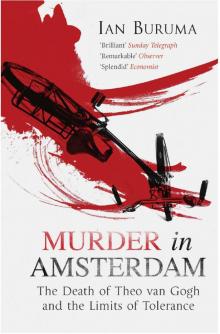
Murder
in
Amsterdam
IAN BURUMA is currently Luce Professor at Bard Higher, New York. His previous books include Voltaire's Coconuts, The Missionary and the Libertine, The Wages of Guilt, Inventing Japan, God'southward Grit and Bad Elements. His nearly recent book, Occidentalism, was published by Atlantic Books in 2004.
'This is the book Ian Buruma was born to write… Buruma understands his characters' motives meliorate than they do… All existence well, this will be the only volume he ever has to write near his native land.' Simon Kuper, Financial Times
'Illuminating… Such a nuanced exploration stands in rebuke to much of the lazy polemic written about European Muslims today.' Natasha Walter, Guardian
'Absorbing and revealing… An specially vital volume for British readers now.' Boyd Tonkin, Independent
'Diligently researched… This is a fine and balanced book… A repose warning that this horror could happen anywhere.' Bryan Appleyard, Lord's day Times
'A thoughtful book on the assassination of controversialist film-maker Theo van Gogh. Murder in Amsterdam takes united states of america into the disoriented, hate-filled lives of the Moroccan and Turkish immigrant community, exploding the niceties of laissez-faire multiculturalism.' Justin Marozzi, Evening Standard Books of the Year
'Equally well as showing there is a lot more than to The netherlands than tulips and canals, [Buruma] elegantly dissects Europe's attempts to cope with the new terrorism.' Nick Cohen, Evening Standard Books of the Year
'Bleak scenarios are tempered with wry observations… An admirably lucid stance in a hysterical climate.' Arwa Haider, Metro
'A little wonder of fine, transparent, reflective reporting – the best kind of writing.' John Lloyd, Glasgow Herald
'A wonderfully readable and provocative investigation of the problem, weaving through it the stories of a pocket-sized group of characters who are primal to the murder.' Bill McSweeney, Irish Times
'A revealing portrait of the country as it now is, a portrait far removed from more traditional images… Buruma's account of Fortuyn is one of the best available in English.' Peter Mair, London Review of Books
'[Buruma's] reporting tin't be faulted; he writes […] elegantly, and he gives a adept and idea-provoking sense of the complexity of the cross-currents that inform this particular, and specially strange, historical moment.' Sam Leith, Spectator
'Ian Buruma's splendid new book […] produces a persuasive analysis of the rise of radical Islam in kingdom of the netherlands.' Economist
'If you lot don't read anything else before the end of the year, read Ian Buruma'due south thoughtful, provocative essay on what happened when Theo van Gogh, an outrageous, often offensive picture show-maker, was murdered in Amsterdam past a young Morroccan Dutchman… This is compelling stuff. Don't miss it.' Julia Neuberger, Jewish Relate
'Genius… Buruma infiltrates the narcissistic milieu of van Gogh and Ali and navigates the globe of Bouyeri brilliantly… But it is on the complexities and contradictions of Dutch guild that Buruma is best, the combination of judgment and guilt, prudishness and prurience.' Robert Pull a fast one on, The First Post (world wide web.thefirstpost.co.uk)
'A shrewd, subtly argued enquiry into the tensions and resentments underlying two of the most shocking events in the recent history of kingdom of the netherlands… Mr. Buruma manages to pick up on nuances and historical threads that other writers might hands overlook [and] with great finesse, explores the sense of displacement and cultural alienation of […] young Muslim men drawn to Islamic fundamentalism.' William Grimes, New York Times
'Buruma addresses questions of political philosophy, moral accountability and mass psychology in the well-nigh rigorous possible way: journalistically.' Christopher Caldwell, International Herald Tribune
First published in the U.s.a. of America in 2006 by
The Penguin Press, a member of PenguinGroup (Us) Inc., 375 Hudson Street,
New York, New York 10014, Us.
First published in Groovy Britain in hardback in 2006
by Atlantic Books, an banner of Grove Atlantic Ltd.
This edition published in Great United kingdom of great britain and northern ireland in 2014
by Atlantic Books Ltd.
Copyright © Ian Buruma 2006
The moral right of Ian Buruma to be identified as the author of this work has been asserted in accordance with the Copyright, Designs and Patents Act of 1988.
All rights reserved. No part of this publication may be reproduced, stored in a retrieval arrangement or transmitted in any form or by any means, electronic, mechanical, photocopying, recording, or otherwise, without prior permission both of the copyright owner and the to a higher place publisher of this volume.
Every effort has been made to contact copyright holders. The publishers will exist pleased to make goodany omissions or rectify any mistakes brought to their attention at the primeval opportunity.
eISBN 9781782395652
Atlantic Books Ltd.
Ormond Firm
26–27 Boswell Street
London WC1N 3JZ
A CIP catalogue record for this volume is bachelor
from the British Library.
www.atlantic-books.co.uk
For Hanca
Contents
Ane
Holy State of war in Amsterdam
TWO
Thank Y'all, Pim
Three
The Healthy Smoker
4
A Dutch Tragedy
5
Submission
Six
A Promising Boy
Vii
In Memoriam
Postscript
Acknowledgments
Notes
Index
ONE
Holy War in Amsterdam
i.
Ton (48), eyewitness to the murder of Theo van Gogh on November 2, 2004: "I heard Theo van Gogh beg for mercy. 'Don't practise it! Don't do it!' he cried. I saw him autumn onto the bicycle path. His killer was so calm. That actually shocked me. How you can murder a person in such common cold claret, right there in the street?
"I had sleepless nights for weeks…. Every night I run across Theo van Gogh fall and Mohammed B. quietly finishing his chore…. Since then I trust very few people. Mohammed B. could be one'due south neighbor. If I say 'fucking nigger' to a Surinamese, I'one thousand called a racist, even though he can call me a whitey. Y'all tin no longer say what you call up these days. No, nosotros've get foreigners in our own country."
NRC HANDELSBLAD, JULY 30, 2005
It was the coolness of his manner, the composure of a person who knew precisely what he was doing, that struck those who saw Mohammed Bouyeri, a 20-6-yr-old Moroccan-Dutchman in a gray raincoat and prayer hat, nail the filmmaker Theo van Gogh off his wheel on a dreary morning in Amsterdam. He shot him calmly in the stomach, and afterward the victim had staggered to the other side of the street, shot him several more times, pulled out a curved machete, and cut his throat—"every bit though slashing a tire," co-ordinate to one witness.
Leaving the machete planted firmly in Van Gogh's chest, he and so pulled a smaller knife from a bag, scribbled something on a piece of paper, folded the letter neatly, and pinned it to the body with this 2nd knife.
Van Gogh, a short fat man with blond curls, was dressed in his usual T-shirt and suspenders. Most people in Holland who lookout Idiot box or read the papers would have been familiar with this ubiquitous figure, known less for his films than for his provocative statements on radio and tv set, in newspaper and Internet columns, and in various courts of law, most everything from the alleged exploitation of the Holocaust by Jewish celebrities to the dangerous presence of a Muslim "fifth column" operating in Dutch society. He lay on his back, his easily stretched above his head, two knives sticking out
from his chest, slaughtered like a sacrificial animal. Bouyeri gave the corpse a few hard kicks and walked away, without hurry, piece of cake as could exist, as though he had washed nothing more dramatic than fillet a fish.
Still calm, he made no serious try to escape. While he reloaded his gun, a woman who happened by screamed: "Y'all can't practise that!" "Yes, I tin can," Bouyeri replied, before strolling into a nearby park with several patrol cars rushing to the scene, "and now you know what yous people tin can expect in the future." A shootout began. 1 bullet struck a policeman in his bulletproof belong. Another striking a passer-by in the leg. But then Bouyeri caught a law bullet in his ain leg and was arrested. This was not part of the plan. Bouyeri had wanted to die every bit a martyr to his organized religion. We know this from statements he made afterwards, and from the letter on Van Gogh's chest.
The content of Bouyeri's alphabetic character was non released to the public for several days. Peradventure it was thought to exist too shocking, and likely to provoke further violence. Information technology was in fact a long rambling tract, written in Dutch with a few quotations in Arabic, calling for a holy state of war against the unbelievers, and the deaths of a number of people mentioned by name. The tone was that of a death cult, composed in a linguistic communication dripping with the imaginary blood of infidels and holy martyrs. The Dutch is right but stilted, bear witness of the author's lack of literary skill perhaps, but also of several layers of awkward translation. Much of Bouyeri's knowledge of radical Islamist rhetoric came from English translations of Arabic texts downloaded from the Internet.
The way of Van Gogh's murder, as well, appears to have been inspired past imagery shooting around the earth on websites. A CD-ROM deejay was plant in Bouyeri's apartment with video motion-picture show of more than than twenty-three killings of "the enemies of Allah," including the American reporter Daniel Pearl. These were taken from a Saudi website edited in London. Apart from the detailed images of men of diverse nationalities existence beheaded, the CD independent pictures of a struggling man slowly having his head sawed off, taken from a Dutch porno site.
Bouyeri's "open alphabetic character" was non really addressed to Theo van Gogh himself, just to Ayaan Hirsi Ali, the Somaliborn Dutch political leader, who had made a brusk film with Van Gogh, entitled Submission, dramatizing what she saw as Islamic abuse of women by projecting quotations from the Koran onto the naked bodies of several young women. The picture was beginning shown in a telly program in which Dutch celebrities are asked to select scenes from their favorite films or television shows. Hirsi Ali chose Submission. Selecting ane's own work was unusual, perchance even unprecedented, merely Hirsi Ali was non a run-of-the-mill celebrity. In the year before Van Gogh's murder she had go the nigh prominent critic of Islam in the Netherlands, speaking out in meetings with Muslim women, at political party conferences, and on Idiot box talk shows, repeating her message, over and over, that the Koran itself was the source of fierce abuse. A delicate African beauty, Hirsi Ali had caught the public imagination past the eloquence and confidence of her public warnings against a religion which already had a sinister reputation. Here was a Muslim, or ex-Muslim, from Africa, telling Europeans that Islam was a serious threat. This was a disturbing message in a society used to public figures preaching multicultural tolerance, simply it was also something many people wished to hear, some of the same people who would afterwards turn against her.
Bouyeri'due south letter was addressed to Hirsi Ali, equally a heretic who had rebelled against her childhood organized religion and become a willing tool of "Zionists and Crusaders." She was called a "soldier of evil" who had "turned her back on the Truth." She was "a liar" who would "nail herself to pieces on Islam." She would be destroyed, along with the United states, Europe, and Holland. For death would "split up Truth from lies," and Islam would be "victorious through the blood of martyrs."
Ayaan Hirsi Ali was the most prominent target of this holy rage, but she was not the only one. Her "masters" were described in the letter every bit a Jewish cabal that ruled the Netherlands. This cabal included the mayor of Amsterdam, Job Cohen, a secular man who really tried his best to find mutual ground with the Muslim communities in his city ("belongings things together," as he put it). In a twist of awful irony, Cohen had also been attacked quite viciously by Theo van Gogh, among others, as an appeaser of Islamic extremism.
The shadow of World War Two, the simply war to accomplish the Dutch homeland since Napoleon's invasion, is never far from any Dutch crunch. Van Gogh, with his unfailing instinct for the low blow, compared Cohen to a collaborationist mayor nether Nazi occupation. Nonetheless, in Bouyeri's jihad, Cohen would have to be annihilated. Another member of the declared conduce was Jozua van Aartsen, then leader of the conservative VVD,* People's Political party for Freedom and Democracy, which Hirsi Ali had recently joined equally a member of parliament. The fact that he wasn't Jewish at all was of course irrelevant. In the holy war confronting "Zionists and Crusaders," beginnings counts for less than association.
Van Aartsen, too, invoked the last war. "These people," he wrote in the NRC Handelsblad, the about august of the national newspapers, "don't wish to change our guild, they want to destroy it. We are their enemy, something we have not seen since 1940." His party colleague, the finance government minister, Gerrit Zalm, a personal friend of Van Gogh's, declared that "we" were "at war" with the terrorists, and actress measures would be taken "on all fronts." Matt Herben, leader of the populist LPF** party, founded past the tardily Pim Fortuyn, saw Islamic and Western civilizations at state of war on Dutch soil. Society, he said, "is being threatened by extremists who spit on our civilisation. They don't even speak our language and walk around in funny dresses. They are a fifth column. Theo said this improve than anyone."
First it was a mosque in Huizen—three men tried to torch information technology with turpentine and gasoline. So a mosque in Rotterdam was targeted, though just the door got scorched. There was another arson attempt at a mosque in Groningen. And in Eindhoven a bomb exploded in an Islamic school. Jan Peter Balkenende, the prime minister, chop-chop announced that "nosotros" were non exactly at war; Holland was just "doing battle" against "radicalism." Three Christian churches were attacked, in Rotterdam, Utrecht, and Amersfoort. Some other Muslim school, in Uden, a modest town in the s, was set up on burn down. Someone had written "Theo R.I.P." on the wall. "The state is burning," said the announcer on the goggle box news.
In fact, the land wasn't burning at all. The arsonists in Uden were a bunch of teenagers looking for kicks. The "civil war" that some feared, the pogroms on Muslim areas, the retaliations by newly recruited jihadis, none of this actually happened. Most people kept their absurd. But the constant chatter of politicians, newspaper columnists, television receiver pundits, headline writers, and editorialists in the popular press produced a feverish temper in which the smallest incident, the slightest fake pas, would spark endless rounds of overheated commentary.
An orthodox imam from Tilburg refused to shake the hand of Rita Verdonk, minister for the integration of minorities. With all respect, the Syrian-born cleric said in halting Dutch, she was a woman, and his organized religion forbade physical contact with strange women. "Merely surely we are equals," replied Verdonk a little peevishly, unsure what to do with her outstretched hand. She was right, they were equals, only equality may not have been the bespeak. The imam'south refusal, maladroit no dubiousness, but not of huge significance, made the front folio of every major newspaper. The sturdy figure of Rita Verdonk facing the bearded imam became a prime symbol of the Dutch crisis, of the collapse of multiculturalism, the finish of a sweetness dream of tolerance and light in the virtually progressive footling enclave of Europe.
ii.
Forty Moroccan, Dutch, political, religious, and homosexual organizations from Amsterdam distributed posters with the slogan: "We won't take this." People are invited to sign a manifesto on the website www.wewonttakethis.
NRC HANDELSBLAD, Nov 16, 2004
It was at this indicate that I decided to spend some time in the Netherlands, where I was born in 1951 and had lived until 1975. I had known Van Gogh slightly. We had mutual friends and did the od
d radio show together. He invited me to exist on his Television receiver talk evidence, called A Friendly Conversation, which, in fact, it was. Non being a fellow member of Amsterdam café club or the local literary scene, I had escaped the lash of his often venomous polemics. His behavior to me was invariably polite, even though his loud, loftier-pitched vocalism, e'er striving to be heard, could exist tiresome.
I arrived with an American magazine assignment in time for Verdonk'southward attempted handshake, only as well belatedly for the memorial political party organized by "the Friends of Theo" according to the precise specifications of Van Gogh himself, fatigued upwardly while planning a trip to New York a few months earlier (he suffered from a fear of flying). At that place was a rock band and at that place were cabaret acts. Pretty cigarette girls in miniskirts plied their wares, as in a prewar movie theater. Female guests wore strings of pearls and twinsets, a manner that Theo had found a turn-on. Since one of Theo's favorite terms for Muslims was "goat fuckers," well-known comedians made jokes about fucking goats, and two stuffed goats stood on a makeshift stage, fix for "those who might experience the urge." A large wooden coffin, supposedly containing Theo'south corpse, was placed on a revolving platform flanked by magnum bottles of champagne, and big phallic cacti, the trademark of his boob tube conversation bear witness. Ane Friend of Theo, present at this wake for a more than frivolous age, predicted to me that if the Muslim radicals weren't crushed soon, there would be a civil state of war in Kingdom of the netherlands.
In that location was something unhinged about the netherlands in the winter of 2004, and I wanted to sympathize information technology ameliorate. Hysteria, later all, is the last thing people associate with a state that is usually described by lazy strange journalists as "phlegmatic." I had always known this to be a extravaganza, but had still found it likewise placid for my taste, too reassuringly dull. This, clearly, was no longer the instance. Something had changed dramatically in the land of my birth.
One of the first things I read later arriving in Amsterdam was an essay by the smashing Dutch scholar Johan Huizinga, written in 1934, some other time of crisis, when fascism and Nazism were looming close to the Dutch borders. Simply extremism would non seduce the Dutch, he said, and even if it did, against all the odds, information technology would surely be a "moderate extremism." Fifty-fifty though The netherlands was non immune to the dangers of mod propaganda and the aging of faith in democratic institutions, the stolid Dutch burghers were simply not given to excesses. As Huizinga saw it, the "mental basis" for collective illusions was a "political sense of inferiority" grounded in centuries of failure and oppression, and a deeply felt loss of ancient glory. Exasperated nationalism is the usual outcome, filled with a want for revenge. Such was not the case in kingdom of the netherlands, for "as a nation and a state we are later all satisfait, and it is our duty to remain so."
DOWNLOAD HERE
Posted by: florenedoubetter.blogspot.com